Small speakers, proper sound, one remote
The problem was a familiar one in an apartment: good sound mattered, but the equipment was taking up too much of the room. I wanted a smaller physical presence without losing the convenience of turning on the TV and using the same remote for everything.
I already knew the sound I liked. As a teenager, I had seen a Bose 321 at a friend’s parents’ place. Two tiny speakers, a neat console and a bass module tucked away. It showed me that a system could sound substantial without looking substantial. Years later, I bought a used one for AUD $250 and enjoyed it for exactly that reason.
The connections aged more quickly than the speakers. The project became a question of whether I could keep that compact sound and give it the everyday behaviour of a modern system.
What the newer systems got right
The Sony HT-A9 that followed stayed for four years. Its surround and height effects could be impressive, and its control was easy to appreciate. Turn on the TV and it woke up. Use the Apple TV remote and the volume changed. Spotify was available without a separate ritual.
But the speakers occupied space around the TV and sofa. Eventually I found I valued a less crowded room more than the extra spatial effects. A white Bose Smart Ultra Soundbar and Bass Module 700 bundle, bought for AUD $1,999, looked like the obvious answer.
It was neat and convenient. I simply preferred the sound of the older Bose speakers. That is a listening preference, not a claim that an older format is universally better. It was enough to make me try a different route.
Then a Bose CineMate GS Series II appeared on eBay for AUD $50. Two small speakers, an Acoustimass bass module and an interface module. It gave me a low-cost way to test the idea.
Separate the sound from the connections
The CineMate could do the acoustic work. The small speakers handled their part of the sound and the bass module supplied the low end they could not produce on their own. What the system lacked was a convenient way to talk to current sources.
I used a WiiM Ultra to handle that side. It receives TV audio through HDMI ARC, handles streaming and equalisation, and sends the audio to the Bose through an optical cable. Equalisation, or EQ, adjusts the balance of frequencies. It lets the sound be tuned without replacing the speakers.
ARC means Audio Return Channel. It lets a TV send sound back down a compatible HDMI connection to the audio system. Optical, also called Toslink, carries digital audio to the older Bose. It does not carry the TV’s control commands, so the control work has to be handled elsewhere.
That division is the central idea. The Bose does not need to understand an app or streaming service. The WiiM translates the modern sources into an audio signal it can use.
Why this became a split soundbar
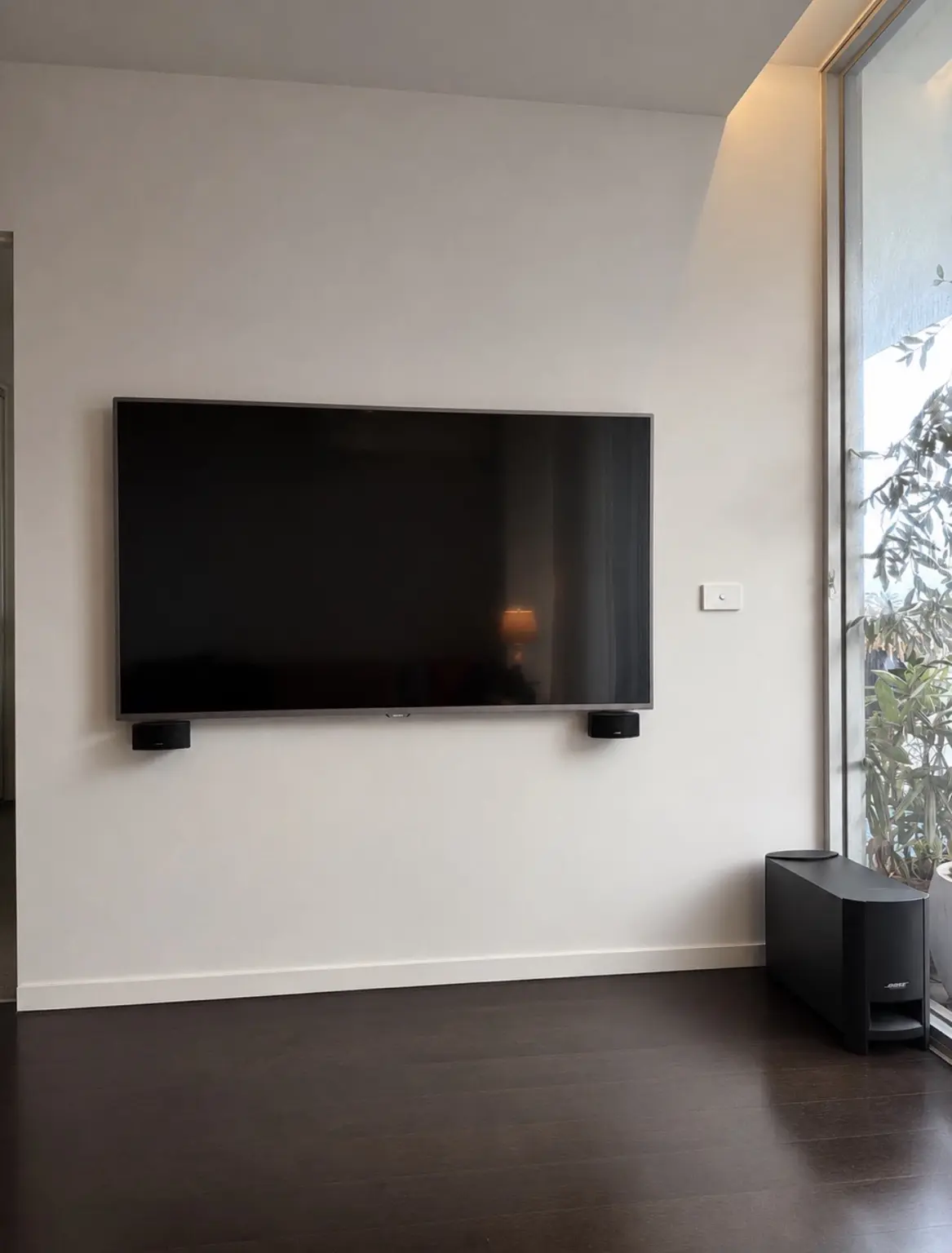
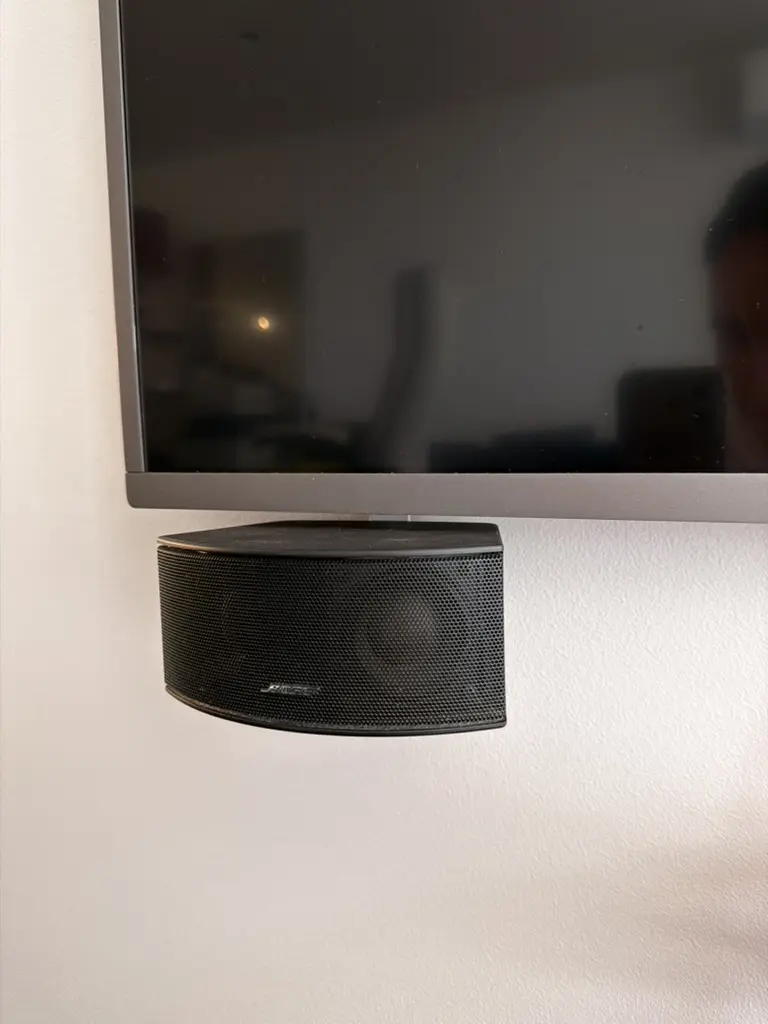
The speaker size was essential. If the result needed stands or large cabinets beside the screen, I would have traded one space problem for another. The GS speakers were small enough to sit just beneath the TV.
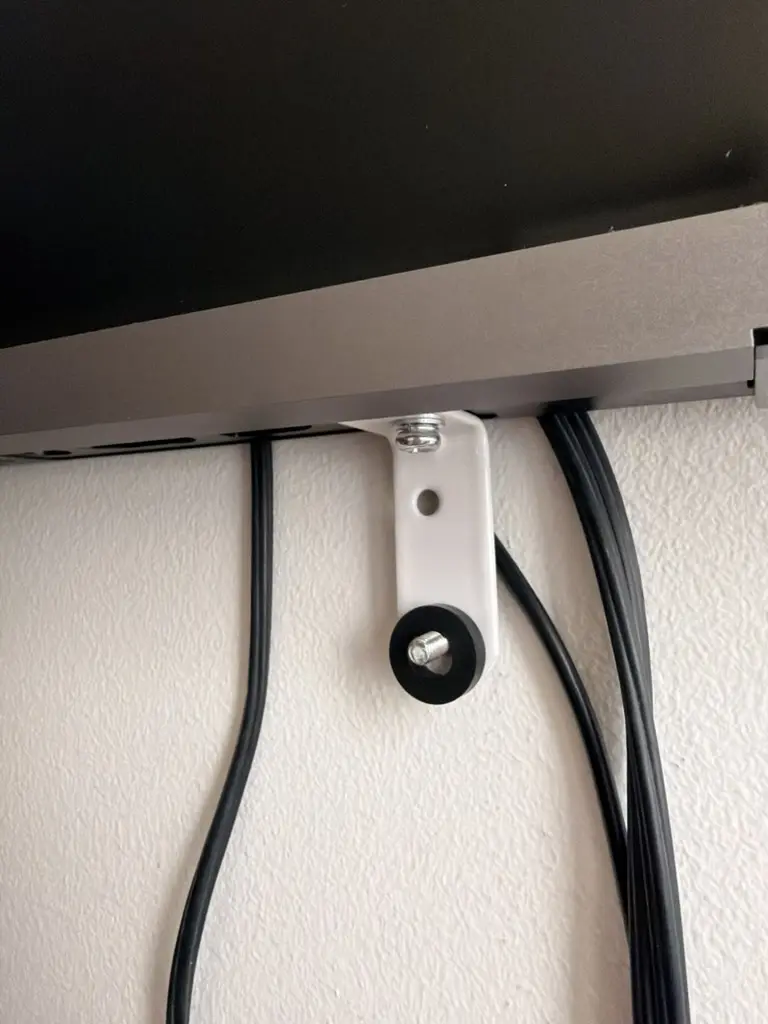
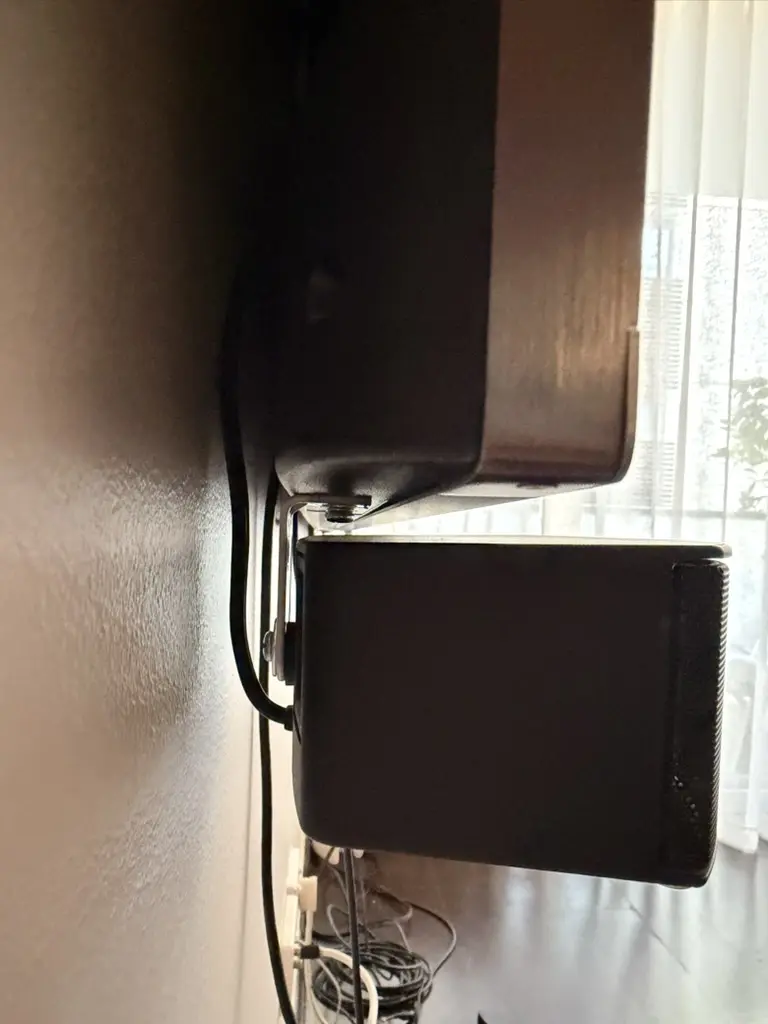
I used L brackets at the TV’s foot screw points to support them. From the front, the pair read as part of the screen arrangement rather than separate furniture. They were not widely separated, but I liked the listening result and the way they occupied the room.
That mounting detail belongs to this particular setup. A similar idea needs its own check of the TV’s mounting points, screw engagement, loads and clearances. The useful lesson is to plan the physical integration as carefully as the signal path.
Getting the ordinary remote to do the work
A second remote would have undermined the point of the exercise. The intended daily action was the familiar one: pick up the Apple TV remote and adjust the sound.
HDMI-CEC is the control link that lets compatible HDMI-connected equipment exchange commands. In this arrangement, volume commands travel through the TV to the WiiM. The WiiM changes the level of the audio it sends over optical. The Bose stays at a suitable baseline level.
That is why an optical connection can work here even though it does not carry volume commands. The audio itself is being made quieter or louder before it reaches the Bose. The old system is not being asked to interpret the modern remote.
The balance between those levels matters. Set the Bose too low and the useful range on the WiiM shrinks. Set it unnecessarily high and a source change can be uncomfortable. I wanted a useful everyday range, a sensible maximum volume and button steps that did not feel like jumps.
The WiiM’s source adjustments were useful for the same reason. TV and streaming should not feel like two unrelated systems simply because they enter through different connections. Volume behaviour is part of the design, not just a setting to leave at its default.
Waking up is a separate problem
Audio and volume were only part of it. The CineMate still needed to wake without somebody reaching for its original remote.
Cinesense provided the bridge. It sits inline at the CineMate interface connection and watches for optical activity, using that to trigger wake and sleep behaviour. This was a reason to choose the CineMate for the experiment rather than try to reuse the old 321 in exactly the same way.
There is an important distinction between a feature being supported and the complete sequence working well. Does the system wake for the TV? What happens after streaming music? When does it sleep? Those are separate transitions to rehearse, not assumptions to make because sound comes out once.
The AUD $50 system was only the starting point
The second-hand CineMate cost AUD $50. That was not the cost of the finished arrangement. The WiiM, Cinesense, brackets and cabling all belonged in the budget, along with planning the power and concealed cable routes.
The installation plan also included a recessed AV box and final in-wall routing. These details determine whether the result looks resolved and remains serviceable. A low purchase price is useful, but it does not remove the cost or time of bringing the equipment together.
I would compare the whole arrangement with the alternative before recommending this route for another space. Reuse makes sense when the retained equipment has something worth keeping and the added work is proportionate. Sometimes a conventional soundbar will be the simpler answer.
What worked, and what still needed checking
I preferred the sound to the soundbar and the small speakers met the space brief. Those were the reasons to keep developing it.
At the point recorded here, Spotify-to-TV handover, volume reporting through the Philips TV, Cinesense’s sleep behaviour and the final concealed cabling still needed to be worked through. I would not describe those as finished tests.
The next pass needed to follow normal use: watch TV, switch to music, leave the room, return and start the TV again. Repeat it at different volume levels. A system can sound excellent during setup and still be irritating if those transitions are awkward.
The useful lesson extends beyond audio
This project worked because I separated what I wanted to keep from what needed to change. The speakers had a sound and scale I liked. Their connections and control needed help. Replacing every part was not the only way forward.
The same question is useful with lighting and automation. Is the fitting itself wrong, or is it badly placed? Does a blind need replacing, or does it need a better control? Is a system missing capability, or is its everyday operation just poorly resolved?
The goal is a space that asks less of the person using it. In this case, that meant small speakers, satisfying sound and an ordinary remote. The interesting technical work happened behind that simple brief.